
21. Padres: Coleman Borthwick, RHP, South Walton HS, Fla. (No. 43)
Well, this was one of the least surprising developments in the Draft. It was never a question of if the Padres would take a high school player, but which one. And they opted for Borthwick, the big right-hander – and top prep righty in the class – over someone like lefty Carson Bolemon. It’s the 10th straight first round the Padres have gone with a prep player; the last time they took a college player was Cal Quantrill in 2016.
22. Tigers: Cameron Flukey, RHP, Coastal Carolina (No. 15)
I wonder if we might start seeing a run on college arms in the latter part of this round now; both Jim Callis and I mocked it that way, and it’s a matter of the order of how they go. Flukey started the year as a potential top-of-the-round-type talent, but he missed a large portion of the season with a stress rib fracture. This ends a run of four straight years of the Tigers taking hitters in the first round, and they haven’t taken a college arm since Casey Mize was the No. 1 overall pick in the 2018 Draft.
23. Cubs: Cade Townsend, RHP, Mississippi (No. 35)
2026 MLB Draft
Re: 2026 MLB Draft
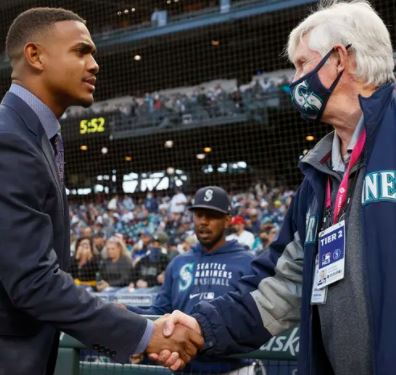
Looks like Ace Reese is the pick at #24 for the Mariners. He isn't a 3rd baseman in the majors. They must really like the bat.

Re: 2026 MLB Draft
ACE is the Place. Ace of Spades. Coming up Aces!
~
~
- ACE.jpg (293.66 KiB) Viewed 111 times
Rocky Colavito is a Hall of Famer in my book!
-
Seattle or Bust
- Posts: 11597
- Joined: Wed Mar 09, 2022 7:09 pm
Re: 2026 MLB Draft
i know nothing about college ball. but many drafts had him going 12 to the Angels.
Re: 2026 MLB Draft
Ace Reese is a 6'5", 220-pound left-handed hitting third baseman (INF) from Mississippi State whom the Seattle Mariners selected with the 24th overall pick in the first round of the 2026 MLB Draft.
Background and College PerformanceReese transferred to Mississippi State from Houston and had an outstanding two-year run there as a power-hitting corner infielder. He posted back-to-back 20+ HR seasons (one of only three players in program history to do so, alongside legends like Will Clark and Rafael Palmeiro). In 2026, he hit around .328-.341 with 24 HRs, high RBIs/runs, and solid walk rates, while showing the ability to drive the ball to all fields with plus raw power and bat speed.
Scouts love his offensive upside: a compact, leveraged lefty swing with plus power potential (often projected as a .260-ish hitter with 25-30 HR pop in the big leagues). He makes contact well for a power guy but has some swing-and-miss concerns (K-rate around 21-22% in college).Positional Outlook: Third Base or First Base?This is the main question with Reese. He played almost exclusively third base in college (started 57 games there as a sophomore, for example) and has a solid arm, but his defense is a significant concern for scouts.
He's a below-average athlete with limited range, quickness, and footwork at the hot corner. His hands and actions need work, and at 6'4"/220 lbs, he's already a big-bodied player whose body may continue filling out.
Most scouting reports project him as a tweener who has a chance to stick at third short-term but is more likely to move off the position long-term due to fringe athleticism and range.
Common landing spots if he moves: First base (where his size and power fit perfectly) or possibly left field/corner outfield. Many evaluators see him as a future 1B/LF type whose bat will carry him regardless.
The Mariners' system has some infield depth, but corner spots (especially 1B) have been a need area. Reese's profile aligns with the common path for big, power-oriented third basemen who shift inward as pros (think players like Andrew Vaughn or similar power-first profiles).Bottom line: He'll likely start his pro career at third base to see what he can handle, especially given his college reps there. But the consensus is he'll have a better long-term fit at first base, where his power bat plays up without defensive demands holding him back. His offensive ceiling makes him a high-upside pick either way.
He's a classic "buy the bat" first-rounder. Keep an eye on his defensive development in the lower minors.
Background and College PerformanceReese transferred to Mississippi State from Houston and had an outstanding two-year run there as a power-hitting corner infielder. He posted back-to-back 20+ HR seasons (one of only three players in program history to do so, alongside legends like Will Clark and Rafael Palmeiro). In 2026, he hit around .328-.341 with 24 HRs, high RBIs/runs, and solid walk rates, while showing the ability to drive the ball to all fields with plus raw power and bat speed.
Scouts love his offensive upside: a compact, leveraged lefty swing with plus power potential (often projected as a .260-ish hitter with 25-30 HR pop in the big leagues). He makes contact well for a power guy but has some swing-and-miss concerns (K-rate around 21-22% in college).Positional Outlook: Third Base or First Base?This is the main question with Reese. He played almost exclusively third base in college (started 57 games there as a sophomore, for example) and has a solid arm, but his defense is a significant concern for scouts.
He's a below-average athlete with limited range, quickness, and footwork at the hot corner. His hands and actions need work, and at 6'4"/220 lbs, he's already a big-bodied player whose body may continue filling out.
Most scouting reports project him as a tweener who has a chance to stick at third short-term but is more likely to move off the position long-term due to fringe athleticism and range.
Common landing spots if he moves: First base (where his size and power fit perfectly) or possibly left field/corner outfield. Many evaluators see him as a future 1B/LF type whose bat will carry him regardless.
The Mariners' system has some infield depth, but corner spots (especially 1B) have been a need area. Reese's profile aligns with the common path for big, power-oriented third basemen who shift inward as pros (think players like Andrew Vaughn or similar power-first profiles).Bottom line: He'll likely start his pro career at third base to see what he can handle, especially given his college reps there. But the consensus is he'll have a better long-term fit at first base, where his power bat plays up without defensive demands holding him back. His offensive ceiling makes him a high-upside pick either way.
He's a classic "buy the bat" first-rounder. Keep an eye on his defensive development in the lower minors.
Re: 2026 MLB Draft
Here's the end of the first round.
23. Cubs: Cade Townsend, RHP, Mississippi (No. 35)
One of the better sophomore-eligible players in the class, Townsend had some helium as Draft day approached, with his name starting to pop up in the 20s. I had thought the Cubs were in on arms (I had the wrong one projected in the end), and Townsend brings a legitimate five-pitch mix – led by three plus offerings in his slider, cutter and curve – to an organization that needs pitching.
24. Mariners: Ace Reese, 3B, Mississippi State (No. 18)
We had been hearing Reese higher than this, and the Mariners likely didn’t think he’d get here. A transfer from Houston who hit 45 homers over the past two years, the left-handed slugger can hit to all fields. He has work to do to stick at third and could end up at first or left field, but the M’s are buying the bat here.
25. Brewers: Trey Ebel, SS, Corona HS (No. 107)
Does Dodgers third-base coach Dino Ebel have any more kids? Because if he does, let’s mock him to the Brewers in the future. The Brewers took Trey’s older brother Brady last year No. 32 overall and signed him for $2.75 million. Now the brothers will be reunited, and some feel Trey is a more complete player than Brady, one who can really hit and has a good chance to stick at shortstop.
23. Cubs: Cade Townsend, RHP, Mississippi (No. 35)
One of the better sophomore-eligible players in the class, Townsend had some helium as Draft day approached, with his name starting to pop up in the 20s. I had thought the Cubs were in on arms (I had the wrong one projected in the end), and Townsend brings a legitimate five-pitch mix – led by three plus offerings in his slider, cutter and curve – to an organization that needs pitching.
24. Mariners: Ace Reese, 3B, Mississippi State (No. 18)
We had been hearing Reese higher than this, and the Mariners likely didn’t think he’d get here. A transfer from Houston who hit 45 homers over the past two years, the left-handed slugger can hit to all fields. He has work to do to stick at third and could end up at first or left field, but the M’s are buying the bat here.
25. Brewers: Trey Ebel, SS, Corona HS (No. 107)
Does Dodgers third-base coach Dino Ebel have any more kids? Because if he does, let’s mock him to the Brewers in the future. The Brewers took Trey’s older brother Brady last year No. 32 overall and signed him for $2.75 million. Now the brothers will be reunited, and some feel Trey is a more complete player than Brady, one who can really hit and has a good chance to stick at shortstop.